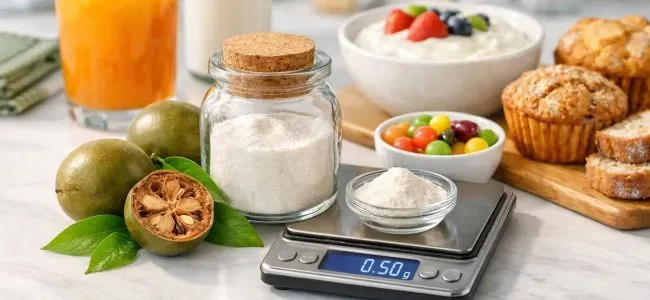
Sugar reduction is no longer a niche request from a handful of health-conscious brands; it’s become a standard formulation brief across bakery, beverage, dairy, and supplement manufacturing. Among the natural sweeteners manufacturers are turning to, monk fruit extract powder has stood out for a simple reason: it delivers intense sweetness with none of the calories, glycemic impact, or bitter aftertaste that come with sugar alternatives like stevia or artificial sweeteners.
This guide goes beyond the basics. It covers what monk fruit extract powder actually is, how it’s produced, where it performs best in manufacturing, how it compares to other sweeteners, and how to choose the right grade, such as Monk Nectar® MV15% or MV25%, for your formulation.
What Is Monk Fruit Extract Powder?
Monk fruit extract powder is derived from Siraitia grosvenorii, a small melon native to southern China, traditionally used there for centuries before becoming a mainstream food ingredient globally. The sweetness doesn’t come from sugar at all; it comes from a group of naturally occurring compounds called mogrosides, found in the fruit’s flesh. Mogrosides can be several hundred times sweeter than sucrose by weight, which is why only a small amount of extract is needed to replace a much larger quantity of sugar.
To turn the fruit into a manufacturing-ready ingredient, the mogrosides are extracted from the fruit, purified, and dried into a stable powder. The concentration of mogrosides in the final powder is what determines its grade and sweetness intensity, commonly expressed as a percentage. MV15% is approximately 60 times sweeter than sugar, while MV25% is approximately 100 times sweeter than sugar.
Because sweetness scales with mogroside concentration rather than the total weight of powder used, manufacturers can select a grade based on how concentrated a dose they need for a given formulation, rather than defaulting to a single standard product.
How Monk Fruit Extract Powder Is Made
Understanding the basic production process helps explain why powder behaves the way it does in formulation:
- Harvesting: ripe monk fruit is picked and processed relatively quickly to preserve mogroside content
- Extraction: the fruit is crushed and steeped in water to draw out the mogrosides, similar in principle to steeping tea
- Purification: the resulting liquid is filtered and purified to remove plant fibre, pigment, and other non-sweet compounds, isolating the mogrosides
- Concentration and drying: The purified extract is spray-dried into a fine powder, which is where the format split with liquid extract happens; powder is simply the dried, more concentrated endpoint of the same extraction process.
Key Benefits of Monk Fruit Powder in Manufacturing
- Zero calories, zero sugar, zero glycemic impact: Unlike sugar or sugar alcohols, monk fruit extract powder contributes no calories and doesn’t affect blood glucose levels, making it relevant for reduced-sugar, keto-friendly, and diabetic-friendly product lines.
- Clean, sugar-like taste profile: Mogrosides are generally recognised for a cleaner sweetness curve than some alternatives like stevia, with less of the lingering bitter or liquorice-like aftertaste that can affect consumer acceptance in blind taste tests.
- Easy dry blending: As a powder, it integrates evenly into dry mixes, bakery premixes, protein powders, tabletop sachets, and powdered supplements, without introducing extra moisture that could affect texture, shelf life, or microbial stability.
- Longer shelf stability: Lower moisture content generally supports more stable storage than liquid sweetener concentrates, which matters for manufacturers holding raw material stock across longer production cycles.
- Precise, scalable dosing: Powder is straightforward to weigh out in exact quantities, which matters for small-batch R&D trials as well as scaling a formulation up to full production volume with consistent accuracy.
- Logistics and storage efficiency: It’s lighter to ship and more space-efficient to store in bulk than liquid alternatives, which can meaningfully reduce freight and warehousing costs at scale.
- Heat and pH stability: Monk fruit extract powder is generally stable under heat and across a range of pH levels, making it suitable for baking, cooking, and other thermal processes, though as with any ingredient, final performance should be validated within your specific formulation and process conditions.
Key Applications for Monk Fruit Extract Powder
The powder format tends to be the natural fit wherever a product is already built around dry ingredients, or where precise, small-scale dosing matters:
- Bakery: blends into dry mixes without adding unwanted moisture that could affect texture or shelf life
- Confectionery, suits dry-mix centres and powdered coatings where a liquid sweetener wouldn’t integrate cleanly
- Protein bars & shakes, dry blending compatibility and shelf stability make it a straightforward fit alongside other powdered ingredients.
- Tabletop sweeteners, easy to portion accurately into sachets or sticks
- Nutraceuticals & supplements, fits naturally into powdered capsule, sachet, or tablet formats
- Dairy powders & instant mixes, integrates into the powdered base before the product is reconstituted with liquid
Choosing the Right Grade and Dosage
Because sweetness intensity varies by grade, dosage isn’t one-size-fits-all. As a general starting point for formulation trials, MV15% requires a larger dose relative to MV25% to achieve the same sweetness, but can offer more room for fine control in formulations where very small dosing increments are hard to measure accurately. MV25%, on the other hand, requires a smaller dose to hit the same sweetness target, which can suit products where minimising added ingredient weight or volume matters, such as capsule or tablet formats.
Because mogroside-based sweeteners are highly concentrated, exact substitution ratios should always be trialled and adjusted in your own formulation rather than assumed from a generic conversion chart; sweetness perception can vary depending on the rest of the ingredient matrix, pH, and serving temperature.
Food Safety and Regulatory Considerations
Monk fruit extract is FSANZ approved, meaning it’s recognised as safe for use in food and beverage products under the Food Standards Australia New Zealand code. That said, permitted usage levels and labelling requirements can still vary by product category, so manufacturers should confirm application-specific compliance requirements and request current documentation directly from their ingredient supplier before finalising a formulation for commercial release.
Sourcing Monk Fruit Extract Powder from Monk Nectar®
For manufacturers formulating with monk fruit extract powder, working with a supplier that offers genuine grade flexibility and reliable supply makes a real difference to how smoothly a product moves from trial to production. Monk Nectar®, supplied by Food Ingredient Australia, is available in both MV15% and MV25% powder grades, giving formulators room to match sweetness intensity to their specific application rather than working around a single fixed-strength product.
Monk Nectar® powder is offered in 1 kg, 10 kg, and 25 kg corrugated boxes, with a low 1 kg minimum order quantity, practical for early-stage product trials as well as full-scale production runs. Supply is available immediately, which helps manufacturers avoid formulation delays caused by long lead times. Beyond supply, the Food Ingredient Australia team works directly with formulators to help identify the right Monk Nectar® grade and starting dosage for a given application, rather than leaving that decision to trial and error.
FAQs
1. What is monk fruit extract powder used for in food manufacturing?
A: Monk fruit extract powder is commonly used in bakery, confectionery, protein bars and shakes, tabletop sweeteners, dairy powders, and nutraceutical products, anywhere a dry, zero-calorie sweetener needs to blend evenly into a formulation.
2. What’s the difference between MV15% and MV25% monk fruit extract?
A: Both are powder grades of Monk Nectar®, differing in mogroside concentration and sweetness intensity. MV15% is approximately 60 times sweeter than sugar, while MV25% is approximately 100 times sweeter, giving formulators flexibility depending on the required dosage.
3. Is monk fruit extract powder the same as stevia?
A: No. They’re both natural, zero-calorie, high-intensity sweeteners, but they come from different plants and have different taste profiles. Monk fruit extract powder is generally noted for a milder, cleaner aftertaste compared to stevia’s more noticeable bitter or liquorice-like notes.
4. Is monk fruit powder heat-stable?
A: Yes, monk fruit extract powder is generally heat- and pH-stable, making it suitable for baking, cooking, and other thermal processes, though final performance should always be validated within your specific formulation.
5. Does monk fruit extract powder dissolve well in liquid applications?
A: While the powder can be dissolved into liquids, it’s primarily suited to dry-mix applications. Manufacturers formulating beverages or other liquid products may prefer a liquid monk fruit extract format designed for instant dispersion.
6. How should monk fruit extract powder be stored?
A: As with most powdered ingredients, it should be stored in a cool, dry place in its original sealed packaging to protect against moisture uptake and maintain consistency over its shelf life.
7. What packaging sizes does Monk Nectar® monk fruit extract powder come in?
A: Monk Nectar® powder is available in 1 kg, 10 kg, and 25 kg corrugated boxes, with a minimum order quantity of 1 kg, suitable for both small-batch trials and larger production runs.
Conclusion
Monk fruit extract powder offers food manufacturers a naturally derived, zero-calorie sweetener that’s stable, precisely dosable, and easy to integrate into a wide range of dry and semi-dry applications, from bakery and confectionery to protein products and nutraceuticals. With grade flexibility between MV15% and MV25%, formulators have real control over sweetness intensity without defaulting to a single fixed-strength ingredient.
If you’re exploring monk fruit extract powder for your next formulation, the Food Ingredient Australia team can help you choose the right Monk Nectar® grade and starting dosage for your application.